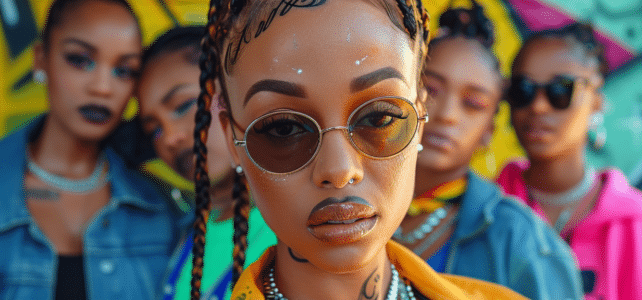
American hip-hop, traditionally dominated by male voices, has also seen the emergence of powerful female figures who have redefined the contours of the genre. These artists have done much more than simply integrate into a competitive field; they have innovated, influenced, and broken barriers. From Queen Latifah to Missy Elliott, through Lauryn Hill and Nicki Minaj, these icons have used their art to express themselves on social, political, and personal themes, while demanding respect for their talent and originality. Their contributions go beyond music; they have shaped popular culture and inspired new generations of artists.
The Rise of Female Figures in American Hip-Hop
In the meanders of hip-hop culture, a change has been underway for decades, reflecting the rise of female artists in a musical genre where male presence has long been predominant. If Queen Latifah, with her stature as the first lady of hip-hop, paved the way, it is an entire pantheon of female rappers that followed, each contributing to the edifice of female rap. From pioneers like MC Lyte, the first female rapper nominated for a Grammy Award, to contemporary icons like Nicki Minaj, the highest-charting female artist, female presence in rap is now undeniable.
These artists, through their success and boldness, have challenged norms and contributed to redefining the style and content of rap. Lauryn Hill, with ‘The Miseducation of Lauryn Hill’, established a new canon, becoming the first female rapper to achieve a diamond record. Missy Elliott, with her debut album ‘Supa Dupa Fly’, not only defied expectations but also became the first female rapper inducted into the Songwriters Hall of Fame. These achievements are not isolated: they are part of a broader movement where female rappers, from Lil Kim to Megan Thee Stallion, are fully participating in the evolution of hip-hop rap.
But the rise does not come without challenges. Each artist carries complex stories, like Lil Kim and her tumultuous relationship with Biggie, or Kimberly Anne Scott and the challenges she has faced. The fight against discrimination and for full recognition remains a daily struggle. Figures like Cardi B, the first female rapper with the most number one singles, or Megan Thee Stallion, crowned ‘Best New Artist’ at the 2021 Grammy Awards, continue to push boundaries and claim their rightful place in the history of the genre. Their voices, their lyrics, their music speak of a life experience that resonates beyond mere charts, leaving an indelible mark on the hip-hop movement.

The Cultural and Social Impact of American Female Rappers
The hip-hop scene, since its origins, has not been spared from debates on gender equality. Despite notable progress, stigma persists, affecting both the reception of female artists and their representation in the industry. From pioneers like Salt-N-Pepa to emerging talents, female rappers have had to navigate an environment where machismo and misogyny often constituted informal but insurmountable barriers. However, consider that their influence goes far beyond the fight for recognition: they shape mindsets, challenge stereotypes, and offer models of resilience.
In this struggle for equality, the musical genre of rap becomes a vehicle for change, a platform to advocate not only for women’s place in music but also in society. The hip-hop culture is enriched by these divergent voices that, through their sharp lyrics and assertive styles, detail the contours of a female experience often relegated to the background. Artists like Rapsody, known for her conscious and engaged underground rap, or 070 Shake, who openly confronts discrimination by embracing her identity as a lesbian, show that hip-hop can be a powerful tool for protest and empowerment.
Music, as an artistic expression, reflects the social and cultural dynamics of an era. American female rappers, by shaking up the codes of a field long dominated by men, contribute to redefining the contemporary musical landscape. The scope of their impact, both culturally and socially, extends far. They open breaches in a once-uniform genre, infusing a necessary and inspiring diversity. Their successes and struggles are part of the collective history, leaving their mark on a hip-hop movement that continues to evolve in rhythm with their demands for justice and equality.