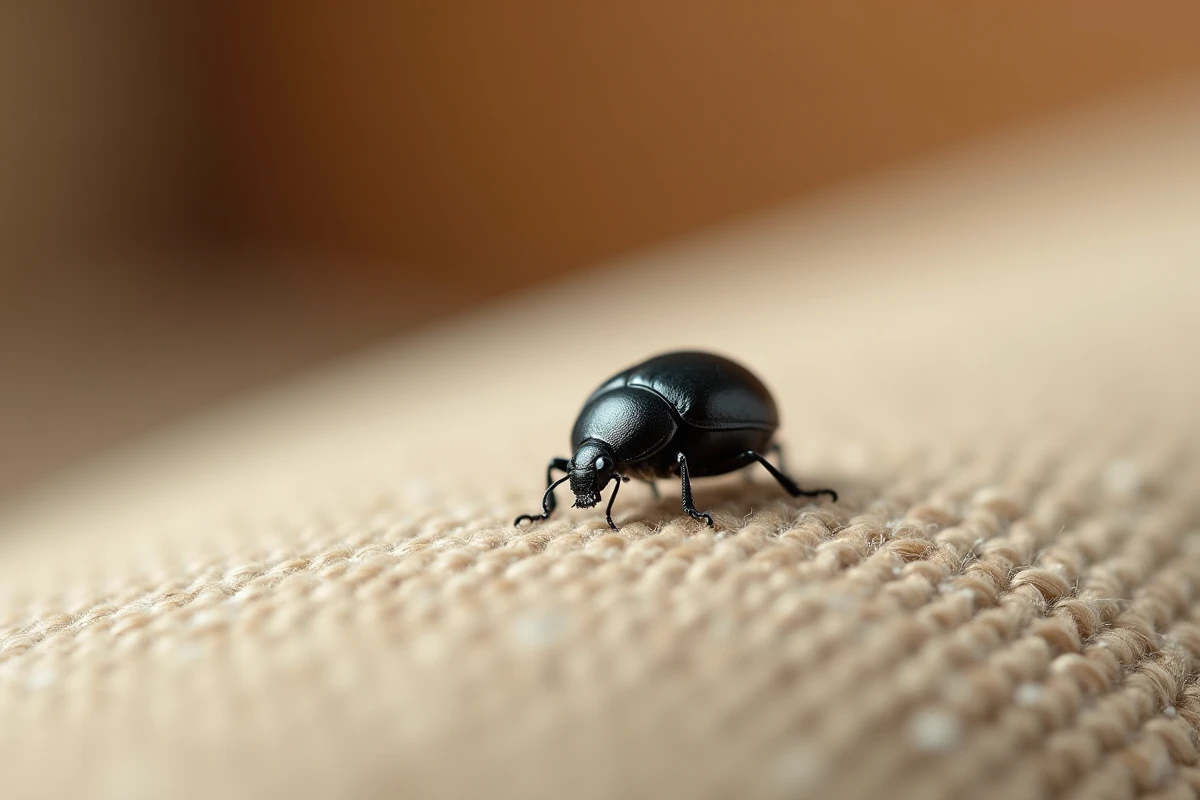
A small black, round insect found on a cushion or between the slats of a bed often triggers the same reaction: bed bug. In most cases, the culprit belongs to a different family, that of textile beetles (anthrenes, attagenes, dermestids). The precise identification of the species determines everything that follows, from targeted cleaning to potential treatment.
Anthrene, attagene or flea: distinguishing criteria on the sofa
The instinct to search for a small black round insect in the house often leads to an endless list of species. Three families account for almost all cases encountered on upholstery textiles.
The adult anthrene measures a few millimeters, has a rounded shell with fine colored scales (brown, beige, black). It is its hairy larva that causes the damage, feeding on animal fibers: wool, silk, feathers. The adult, on the other hand, feeds on pollen and enters through windows.
The attagene is more uniformly black, with an oval body and a hard shell. Its larva, recognizable by its tuft of hairs at the back, attacks the same materials as the anthrene. According to field reports from specialized companies in 2024-2025, the attagene is becoming an emerging domestic pest in large cities like Paris, Lyon, or Montreal.
The flea, however, does not really resemble the previous two: flattened laterally (not round), it jumps. If the insect found on the sofa remains still or flies awkwardly, the flea possibility is quickly ruled out.
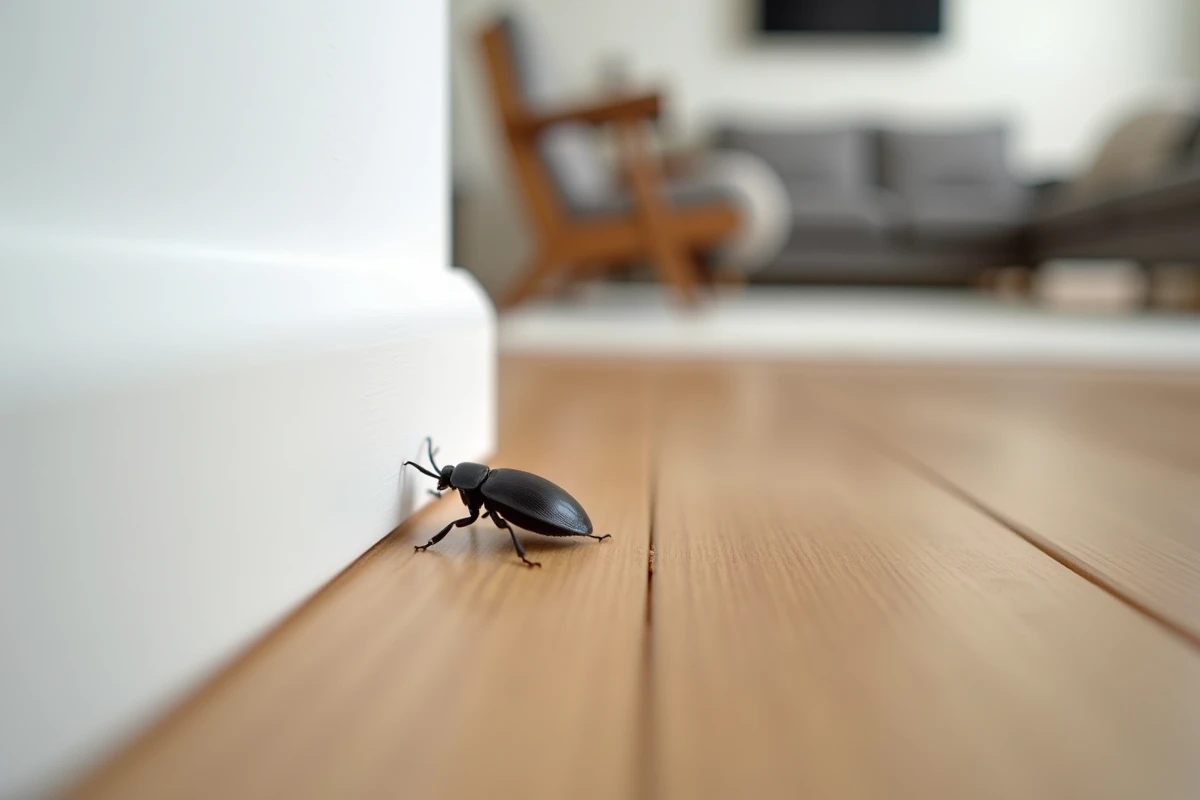
- Round or oval shape, hard shell, slow or absent flight: orientation towards anthrene or attagene.
- Body flattened on the sides, quick jumps: likely flea, often associated with the presence of a pet.
- Flat and oval body (viewed from above), reddish-brown color, sweetish smell: bed bug, which requires a specific protocol.
- Small dark brown beetle found near foodstuffs (flour, rice): weevil or food dermestid, not a textile pest.
Accumulation areas in the house: where to look for larvae
Diagnostic professionals emphasize a point often misunderstood: the presence of adults on the sofa does not mean that the infestation is localized to the sofa. Adults fly or move towards the light. The larvae, however, remain hidden in very specific areas.
Recent diagnostics show that textile beetles thrive in micro-environments neglected during regular cleaning. This is not a general hygiene issue, but rather maintenance that overlooks certain areas:
- Under skirting boards and behind heavy furniture that is rarely moved, where hair, pet fur, and textile fibers accumulate.
- Inside ventilation ducts, roller shutter boxes, and gaps in the flooring.
- In drawers of wool clothing or duvet covers stored without being washed.
Vacuuming only in the center of the room does not address these reservoirs. Vacuuming corners and stored textiles is the most effective preventive measure against anthrenes and attagenes.
The particular case of the bed and bedding
Finding a small black round insect in the bed often points to the bed bug. If the insect has a hard shell and does not leave blood stains on the sheets, the textile beetle possibility is more likely. Anthrene larvae sometimes colonize the mattress ticking or the upholstered base, especially when it is in contact with wool or felt.
Thermal treatment or insecticide: what professionals recommend
The regulatory reduction of certain insecticide molecules in public use in Europe is prompting specialists to favor other approaches. For textile insects, thermal treatment is gradually replacing chemical spraying on surfaces in contact with the skin.
The principle is simple: expose infested textiles to a sufficient temperature (high-temperature washing or tumble drying) to eliminate all stages of development, from eggs to adults. This method avoids chemical residues on upholstery fabrics and works on the entire biological cycle of the insect.
When insecticide remains relevant
Non-washable areas (flooring, skirting boards, boxes) may justify the application of an appropriate biocidal product. Professionals in 2024-2025 emphasize a prerequisite: confirm the species before treatment. A food weevil is not treated like a carpet attagene, and a textile insecticide applied in a food cupboard poses an obvious health issue.
Spraying a generic product without identification amounts to treating blindly, with a risk of unnecessary exposure to biocides in the home and often mediocre effectiveness.
Anthrenes and skin allergies: an effect often confused with bites
Anthrene larvae carry tiny bristles (hairs) that, upon contact with the skin, cause contact dermatitis resembling insect bites. Red patches appear on the arms, neck, or legs, especially upon waking. This clinical picture is frequently confused with bed bug bites.
The key difference: lesions caused by anthrene bristles do not have a central puncture point, unlike bug bites. If the bumps appear without any blood stains on the sheets and without the presence of flattened reddish-brown insects, the allergic possibility related to beetle larvae deserves to be explored with a healthcare professional.
A vacuum cleaner equipped with a suitable filter, used on the mattress and the base, significantly reduces the concentration of larval bristles. Washing sheets and covers at high temperatures complements this action. In most situations involving a small black round insect on the sofa or in the bed, these mechanical actions are sufficient to resolve the problem without resorting to heavy chemical treatment.