
Replacing the timing belt is one of the most dreaded interventions for drivers, not so much for its technical complexity but for the accompanying bill. The price differences between independent garages and dealerships reach levels that warrant detailing the cost items one by one, rather than settling for vague ranges.
Water pump and complete kit: the items that inflate the bill
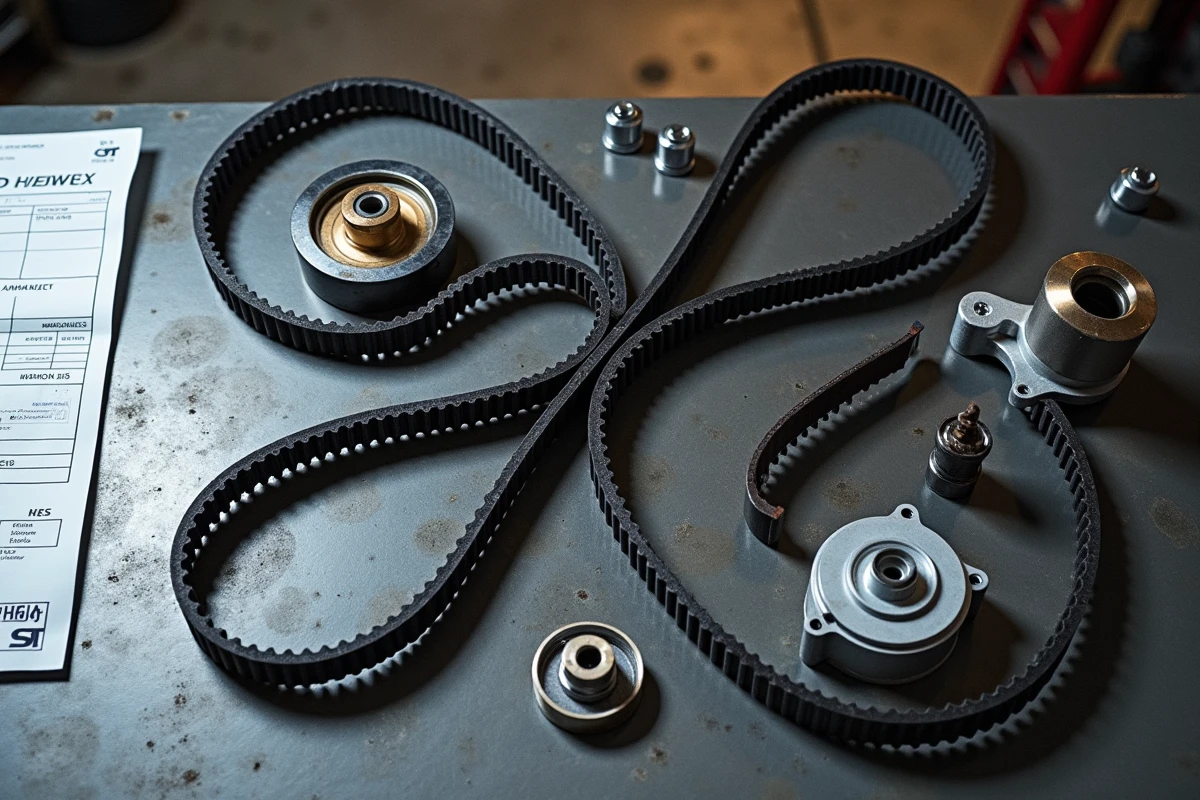
The part itself, the belt, represents only a fraction of the total cost. What really weighs heavily is the complete timing kit (tensioner pulleys, idler pulley, sealing gasket) and especially the water pump, whose simultaneous replacement has become standard practice in 2025-2026.
Mechanics justify this bundling with a common-sense argument: the water pump is located behind the belt. Removing it separately, a few months later, would mean paying for labor twice to access the same area of the engine. The additional cost of the pump added to the kit remains lower than the price of a second intervention.
To understand in detail the timing belt replacement price and rates according to the engine types, one must take into account this systematic inclusion of the water pump, which can vary the bill by several hundred euros.
Difference between independent garage and dealership: why such a gap
Field reports vary on the exact amount, but the trend is clear: the gap between an independent garage and a dealership reaches 50 to 85 % for this service. An independent typically charges between 400 and 700 euros for a complete kit with water pump, while a dealership can exceed 900 euros and go beyond 1,300 euros depending on the brand.
This gap can be explained by three factors that are not mysterious:
- The hourly labor rate, significantly higher at dealerships (premises, specific manufacturer training, certified tools).
- The price of original manufacturer parts, mandated at dealerships, whereas an independent can offer equivalent quality parts (Gates, Dayco, SKF) at a lower cost.
- The billed labor time, sometimes fixed at dealerships based on a high rate that does not reflect the actual duration of the intervention.
Requesting a detailed quote that separates parts and labor remains the only reliable way to compare. A global quote without breakdown prevents any negotiation.
Time criterion for replacement: the trap of low mileage
Most drivers think in terms of kilometers driven. Manufacturer recommendations range between 80,000 and 160,000 km depending on the models and brands (Peugeot, Citroën, Renault, Dacia, Volkswagen, Skoda, Seat). What many do not know is that the time criterion takes precedence over mileage.
The rubber of the belt ages regardless of usage. A car that is driven little, parked in a garage, sees its belt degrade due to oxidation and loss of elasticity. Manufacturer recommendations now converge towards a maximum threshold of six years, even if the recommended mileage is not reached.
A used vehicle purchased without a clear maintenance history represents a particular risk. Without proof of recent replacement, it is better to budget for the intervention right at the purchase rather than gamble on the condition of the belt.
Financial consequence of a timing belt failure
On most current engines, the valves and pistons share the same space. When the belt breaks, synchronization is lost and the valves collide with the pistons. The engine is destroyed in a matter of seconds.
The cost of replacing a complete engine far exceeds that of the belt. For a 1.2 PureTech (fitted on many Peugeot and Citroën models), the engine replacement can reach 10,000 euros. For vehicles over five years old, this amount often exceeds the residual value of the vehicle, leading to scrapping.

Some engines use a timing chain instead of a belt. The chain, being metal, does not require periodic replacement under normal conditions. Checking whether the vehicle is equipped with a belt or a chain can help avoid unnecessary intervention. Recent Volkswagen models, for example, mix both technologies depending on the engine types.
Comparing quotes: points to check before validating
A serious quote for a timing belt replacement should explicitly mention the following elements:
- The exact reference of the timing kit (brand, part number) and whether or not the water pump is included.
- The estimated labor time, expressed in hours, along with the hourly rate applied.
- The mention of the coolant to be replaced if the water pump is changed (an often overlooked item that adds to the final bill).
- The warranty on parts and labor, which varies greatly from one garage to another.
A garage that refuses to itemize its quote or offers a flat rate without detailing the parts does not allow for verification of the quality of the installed components. National chains and independent garage networks generally offer online quotes that facilitate comparison.
Replacing the timing belt remains a significant expense, but it protects against a bill several times higher in the event of a failure. The real lever for savings lies in the methodical comparison of quotes and adherence to the six-year time criterion, a parameter that too many drivers continue to neglect in favor of just the mileage counter.